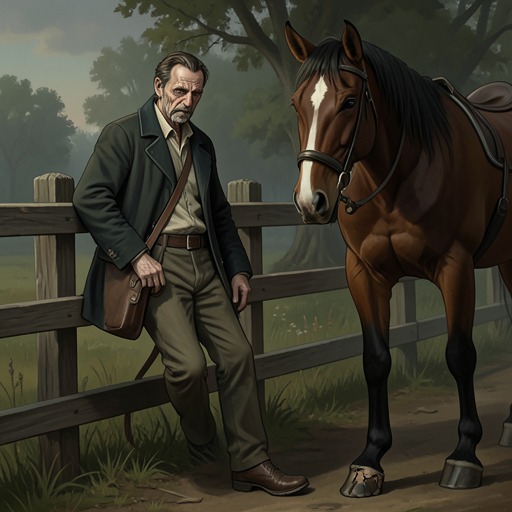
Jerry Gives Up Drinking
Black BeautyJerry Barker’s decision to give up alcohol is a hard-won act of self-command rather than a sudden conversion. He explains that he had not been a drunkard, yet had come to feel that drink controlled him; breaking the habit took weeks of effort and support from Polly Barker. Ten years later, he has not tasted alcohol and says he no longer wants it. When Governor Grant admits that he too has struggled to stop, Jerry turns his own experience into practical encouragement, making private recovery a matter of example and solidarity.
The struggle and decision
Jerry does not present his drinking as harmless simply because he had never become drunk. He tells Governor Grant that he had found he was not his own master: when the craving came, refusing it was difficult. This distinction is central to his account. The problem was not only visible excess, but the loss of control he recognized in himself. He frames the choice as a contest between himself and drink, and says he resolved that he would not be the one to yield, with God’s help.
His effort lasted several weeks. The narrative gives no single dramatic turning point; instead, it stresses that leaving the habit behind required repeated decisions during moments of temptation. Jerry says that he had needed all the help he could get, because he did not understand how strong the habit was until he tried to break it. His later ten years of abstinence therefore mark not an effortless change of character but the lasting outcome of a difficult process.
Practical support and lasting change
Polly Barker’s support is described through ordinary, concrete measures. She took care that Jerry had good food, and when the craving returned he might have coffee or peppermint, or read from his book. These alternatives did not erase the difficulty, but gave him something else to do at the point when he was trying to resist. The account makes recovery relational: Jerry supplies determination, while Polly helps sustain it through care and attention.
Jerry also recalls the arguments he repeated to himself when resistance became hard. He thought of the possibility of losing his soul and of breaking Polly’s heart. In his telling, the choice had consequences beyond his own immediate comfort: it touched his spiritual life and the trust and affection within his marriage. He credits both divine help and his wife, describing the result as his chains being broken. The image gives the change moral weight without suggesting that the struggle was easy or that willpower alone settled it.
Encouraging Governor Grant
The conversation with Governor Grant tests Jerry’s account against another man’s experience. Grant says that he had tried stopping for two days and thought he would die. Jerry answers not by dismissing the difficulty but by describing his own weeks of effort and the strategies that helped him. His admission that the craving was powerful gives his advice credibility: he speaks as someone who has experienced dependence, not as an observer who assumes that stopping is simple.
Jerry urges Grant to try again and points to the value his example might have for other men in their position. He knows that two or three men would like to keep away from the tavern if they could. Abstinence thus becomes more than an individual achievement. Jerry suggests that one person’s successful change might make another person’s attempt seem possible, especially among people who share the same pressures and habits. Grant’s response is tentative: he says he has a great mind to try, recognizing that not being one’s own master is itself a poor condition. The exchange records encouragement, not confirmation that Grant succeeds.
Conduct beyond the question of drink
Jerry’s account of recovery sits within a narrative that repeatedly treats self-command and responsibility as obligations toward others. He refuses a Sunday fare because his cab has a six-day license and taking passengers that day would be illegal. That decision is not presented as part of his sobriety, but it shows him accepting a constraint rather than setting it aside for convenience or payment.
The book also depicts other characters turning concern into action. At Birtwick, the household’s kindness extends to animals, and the Squire and Farmer Grey have worked for years to remove check-reins from cart-horses. When Joe Green encounters horses being mistreated at a brick-yard, he seeks help, offers to testify, and is praised by John Manly for intervening rather than passing by. These episodes do not establish the cause of Jerry’s decision to abstain; they place his encouragement of Grant within a broader moral world where private choices and public responsibility both matter.
Significance
Jerry’s abstinence is defined by the change from feeling mastered by a craving to maintaining ten years without drink. Its account avoids treating recovery as a simple declaration: effort, substitute routines, Polly Barker’s care, and faith all have a place in the process. By recounting those particulars to Governor Grant, Jerry converts a personal history into counsel while acknowledging how hard the change can be. The episode’s emphasis falls on practiced self-government and mutual help: a person who has struggled can offer another not a guarantee, but a credible reason to try.